

How to Choose a Reputable Golf Tournament Organizer: 6 Criteria & 15 Questions
Time 17/08/2026
Choosing a golf tournament organizer is not simply about finding someone to "handle everything" — it is a decision that directly affects your company's reputation in front of hundreds of VIP guests and a substantial budget. Choose poorly, and you may face inaccurate scores, hidden costs that rise after the event, or even a communications crisis when a golfer wins a major prize but is not paid. This article equips you with a set of criteria for evaluating suppliers, 15 interview questions to ask before signing a contract, and warning signs that should be eliminated immediately — so you can choose the right provider, at the right price, with the right quality.
In short: A reputable golf tournament organizer should meet 6 criteria — course booking capabilities, expertise in formats & scoring, Hole-in-One insurance management, onsite coordination, transparent pricing, and a weather contingency plan. Before signing a contract, interview the vendor using the 15 questions in this article and request an itemized quotation for each category.
Why Aren't Online "Golf Tournament Organization Process" Articles Enough to Help You?
If you have searched for a golf tournament organizer, you have certainly encountered two groups of content: golf companies selling all-inclusive services (showcasing the number of partner courses and tournaments organized) and MICE event companies writing generic articles about "5–7 steps to organize an event." Both overlook the most important question for buyers: how do you know whether this vendor is trustworthy?
In reality, the biggest gap in current search results is a supplier evaluation framework: how to break down quotations, identify hidden costs, and cross-check tournament coordination capabilities. This article delves into exactly that aspect. If you need a guide to organizing an event yourself from start to finish, refer to Wingolf's article on the A-Z golf tournament organization process — while this article is for those looking to hire a provider.
6 Criteria for Evaluating a Reputable Golf Tournament Organizer
Don't evaluate a vendor based on a polished capability profile. Verify them through the 6 lenses below — each criterion includes verification questions and signs of whether the vendor meets or fails to meet the standard.
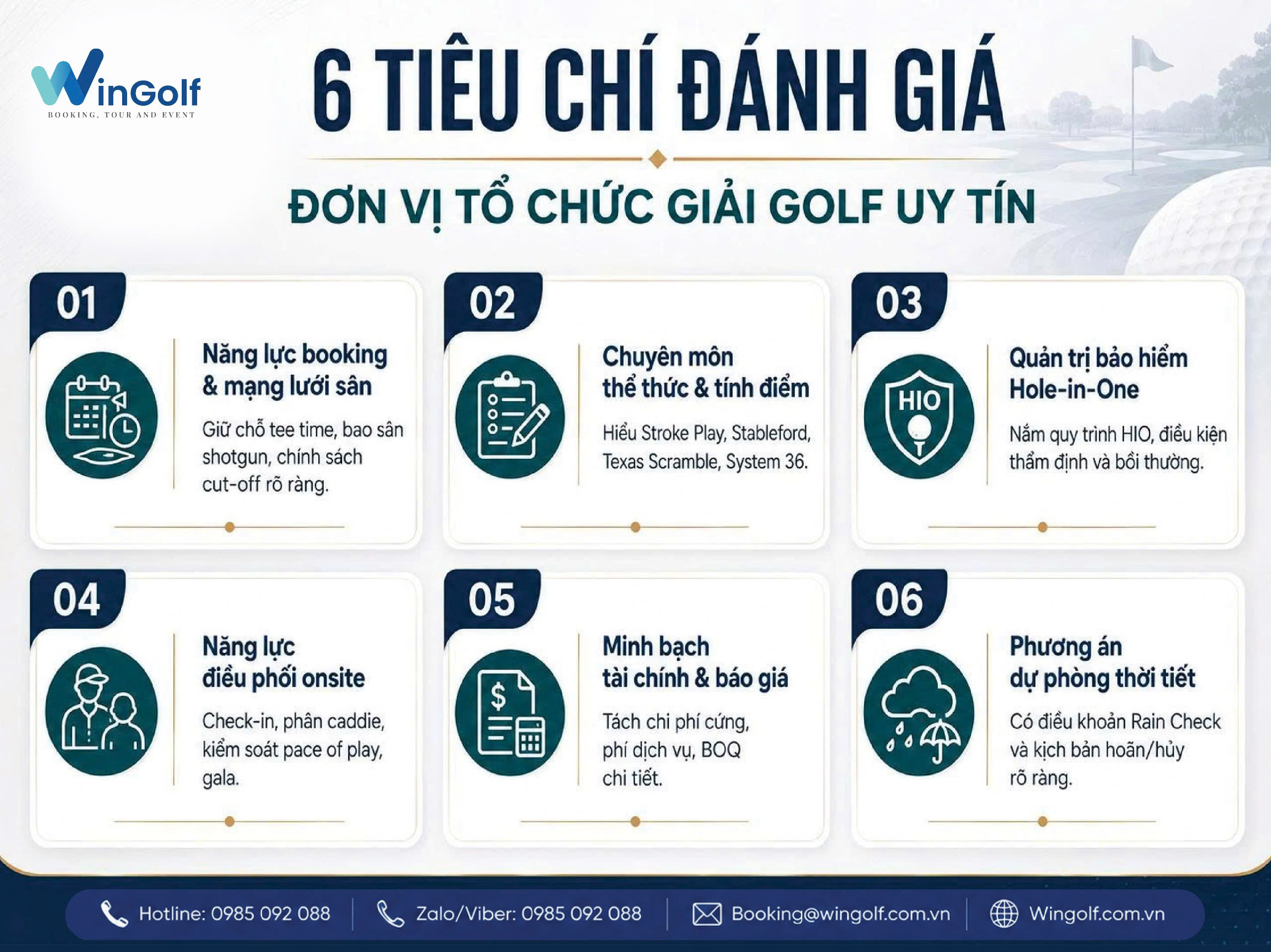
Practical tip: Don't just listen to what the vendor says. Ask them to describe how they would handle a specific situation — for example, "144 golfers have booked the entire course for a Saturday morning shotgun at Montana Golf Course, and a guest cancels at the last minute 12 hours before tee time" — their answer will reveal whether they have real experience or are simply making promises.
Checklist: 15 Interview Questions to Ask a Golf Tournament Organizer Before Signing a Contract
Before signing any contract, schedule a face-to-face interview with the vendor. The 15 questions below are divided into 5 risk categories, along with the reasons for asking them and indicators of a satisfactory answer.
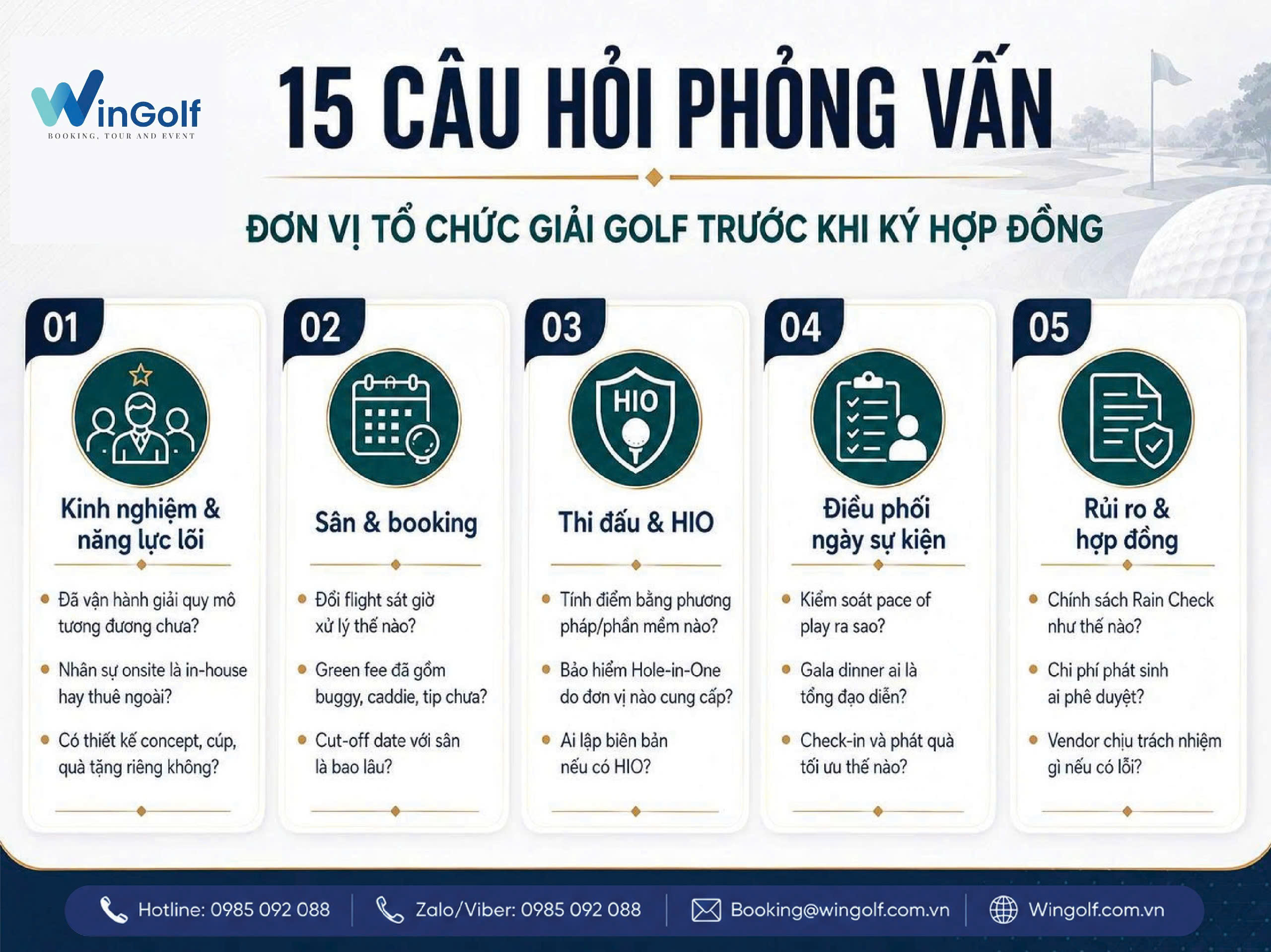
Group 1: Experience & Core Capabilities
- 1. Has the company directly operated tournaments of a comparable scale (150 golfers, shotgun) before? Do they have a portfolio of completed projects? — Eliminate agencies that overstate their capabilities. Managing 150 people teeing off simultaneously is far more complex than a 40-person tournament. A satisfactory answer includes providing actual photos/videos from events of the same scale.
- 2. Is the coordination team made up of in-house staff or outsourced personnel? — In-house staff have greater accountability and understand the service culture better than temporary teams. A satisfactory answer is that the event manager and director are in-house; outsourcing promoters/helpers is acceptable if they are supervised.
- 3. Do they create a custom event identity package (concept, trophy, gifts), or do they use ready-made templates? — A golf tournament is a brand-positioning tool; generic designs diminish its value in front of VIP guests. A satisfactory answer includes 2D/3D design capabilities and a concept proposal tied to the brand story.
Group 2: Course Expertise & Booking
- 4. How are changes to the flight list 12–24 hours before tee-off handled? — Last-minute cancellations by VIP guests are very common. A satisfactory answer includes a process for working directly with the caddie master to make timely adjustments.
- 5. Does the green fee include a shared buggy and caddie fee? How are caddie tips managed? — Identify hidden costs. Typically, tips are paid by the golfer, but for VIP tournaments, a tip fund may be advanced to provide guests with a fully covered package.
- 6. How long before the event is the cut-off date for confirming the number of players with the course to avoid penalties? — This directly affects cash flow. A satisfactory answer clearly explains the timeline (usually 3–7 days) according to the course contract and warns of risks in advance.
Group 3: Competition & HIO Insurance
- 7. Which scoring and ranking method/software is used? — Avoid having guests wait for hours at the gala to hear the results because of errors in manual scoring. A satisfactory answer includes proposing System 36 for amateur tournaments and livescore software that exports results in real time.
- 8. Which company provides insurance for the Hole-in-One prize? What are the exclusions? — Protect the business from the risk of paying out billions of đồng in compensation. A satisfactory answer includes proof of cooperation with PVI or MIC, clearly states the requirements for par-3 holes (typically 130–150 yards for men and 110–135 yards for women), and specifies the supervision regulations.
- 9. Who verifies the validity and prepares the incident report if there is an HIO? — Ensures the insurance claim documents are approved. Successful when there is an arbitration scenario, a camera at the HIO hole, and the course representative co-signs the report.
Group 4: Event-Day Coordination
- 10. How is the pace of play controlled to avoid congestion? — A 6–7-hour tournament exhausts guests and ruins the gala. Successful when marshalls are assigned to coordinate with course staff to remind slow flights.
- 11. What is the gala dinner plan, and who is the show caller? — The gala is the final emotional touchpoint. Successful when a detailed plan is provided (timeline, MC script, sound and lighting) and a specific show caller is appointed.
- 12. How can the check-in and gift distribution flow be optimized so VIP guests do not have to queue? — First impressions define the level of prestige. Successful when the flow is divided alphabetically from A–Z or by flight, or QR-code check-in is used.
Group 5: Risks & Contracts
- 13. How are the Rain Check policy (postponement/cancellation due to weather) and compensation terms defined? — Tropical weather carries the risk of thunderstorms and lightning. Successful when the terms are customized according to the selected course’s regulations (a 9- or 18-hole voucher depending on when play is stopped).
- 14. What process controls additional costs (ordering extra drinks, extending the party)? — Prevents vendors from ordering extras on their own and submitting inflated bills. Successful when all additional expenses require the signature of one and only one authorized company representative.
- 15. What is the vendor’s liability for compensation if a serious error occurs (miscalculating cup scores, misprinting the sponsor’s logo)? — Establishes the highest level of accountability. Successful when the contract includes a penalty clause proportionate to the extent of the damage.
8 Warning Signs: Eliminate the Vendor from the First Round
3 Golf Tournament Organizer Fee Models & How to Compare Quotes
Understanding the financial nature of each model helps you choose a transparent option and protect your cash flow. There are currently 3 common pricing methods in the market:
Tip for comparing quotes apple-to-apple: Don’t look at the “total cost” line at the bottom of the page. Require every vendor to quote using the same two-part structure — hard costs (green fee, caddie, course F&B, HIO insurance — cross-check against the course’s published prices) and production & service costs (staffing, design, MC, photo/video — where the vendor’s true expertise is reflected).
7 Mandatory Contract Clauses
A golf event organization contract is not merely administrative paperwork — it is your legal shield. A watertight contract should include the following 7 clauses:
- Weather & force majeure clause (Rain Check / Force Majeure): Specify in detail — when the lightning alarm sounds, and at which hole the course closes, is the tournament considered finished? In the event of cancellation, will the course issue a voucher for a makeup round or refund what percentage of the green fee? How long is the voucher valid?
- HIO insurance & event addendum: The vendor must attach a valid HIO insurance certificate (PVI, MIC...) at least 24 hours before the opening. If someone wins a prize while the vendor has not activated the insurance, the vendor shall bear 100% of the compensation costs.
- Quantity changes (Cut-off & Fluctuation): Changes in the number of players (e.g., ±10%) within 3–5 days before the event will not be penalized.
- Out of Scope mechanism: Any additional costs may only be incurred with on-site approval signed by the sole authorized representative of the company.
- Safe payment schedule: A common three-installment structure — 50% deposit after signing (to block the course and arrange insurance), 30% three days before the event (to finalize production costs), and the remaining 20% after completion and handover of photos/videos.
- Intellectual property & confidentiality: All original design materials, photos, and videos belong to the company; the vendor may not use VIP customer data for its own commercial purposes.
- Key Personnel commitment: Specifically designate the event director/event manager who will be present on-site — preventing the vendor from using its best staff to win the business and then handing the event over to interns.
Frequently Asked Questions When Hiring a Golf Tournament Organizer
After hiring a full-service vendor, does the company need to send someone to supervise at the course?
Yes. Even if the vendor handles 100% of the operations, the company should still send 1–2 key representatives (someone responsible for the budget or an administrator) to welcome VIP guests and sign confirmations of additional costs on-site — avoiding disputes after the event.
Guests have widely varying skill levels; how can the event be organized fairly?
A reputable vendor will recommend formats that narrow the gap: Texas Scramble (four players per flight playing as a team, reducing pressure on beginners) or System 36 — automatically calculating the day's handicap based on the results, making it fair for both beginners and skilled golfers.
Is the caddie tip included in the quotation?
Usually not — the caddie fee is included in the green fee, while the tip is a personal golfing custom. For a full-service VIP appreciation tournament, the company may ask the vendor to allocate a budget to prepare tip envelopes to be presented at the end of the tournament so guests do not have to pay out of pocket.
Can the vendor seek sponsorship for an expensive HIO prize?
It depends on the vendor's standing — major golf companies have partner networks through which they can solicit in-kind sponsorships. Note: even if the prize is sponsored in kind, the company or sponsor must still pay the HIO insurance premium to PVI/MIC to insure that prize.
Can the course fee be refunded if a guest no-shows at the last minute?
Most courses do not offer refunds for changes after the cut-off (usually 3–7 days). A forward-thinking vendor will recommend preparing a stand-by list to fill vacancies immediately, avoiding wasted course costs.
How far in advance should a 140-person shotgun tournament with an exclusive course booking be prepared?
The ideal lead time is 1.5–2 months. With less than 3 weeks, you face the risk of being unable to book a course (especially weekend morning slots), rush production fees for printed materials, and difficulty scheduling VIP guests.
How Does WinGolf Meet the Above 6 Criteria?
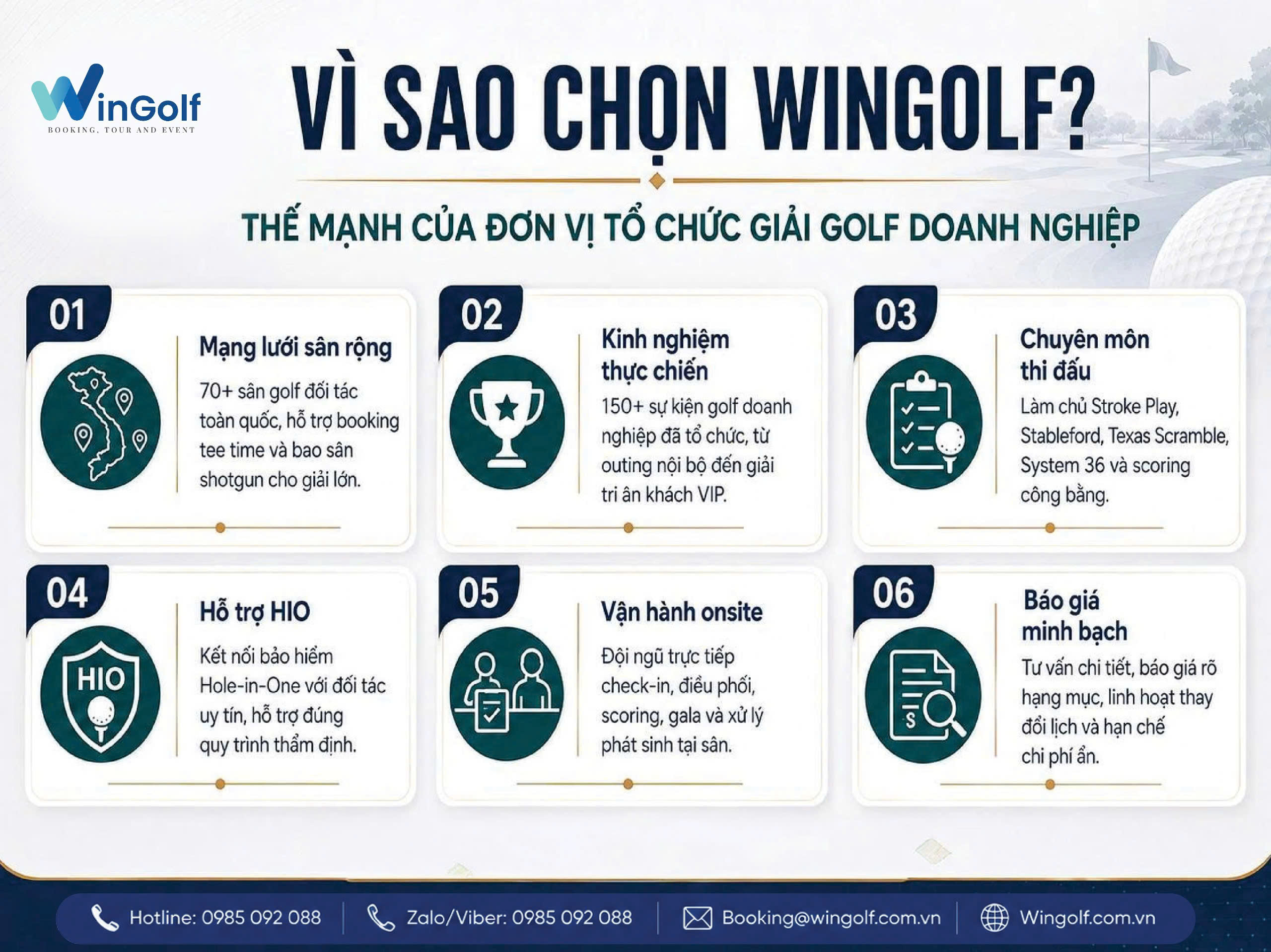
To help you visualize what a qualified vendor looks like, below is how WinGolf — a golf tournament organizer in Hanoi, Ho Chi Minh City, and Da Nang — meets each criterion in the evaluation framework above:
More than 150 corporate golf events organized — from 20-person internal outings to appreciation tournaments for 120 VIP guests — serve as practical proof of the capabilities outlined above. You can use the same set of 15 questions in this article to interview WinGolf before making your decision.
Conclusion
Choosing the right golf tournament organizer means choosing a partner who protects your brand’s reputation in front of VIP guests. Use the 6 criteria to screen candidates, the 15 questions to interview them, the 8 red flags to eliminate unsuitable options, and the 7 clauses to finalize the contract.
And if you want a partner whose capabilities have been proven through more than 150 real-world events, let WinGolf provide a free consultation — you’ll have a standardized quote to compare before making your decision.
Ready to organize your corporate golf tournament?