

What Is OB (Out of Bounds) in Golf? White Stakes, Penalty Strokes & Local Rule E-5
Time 30/10/2026
For anyone in their first year of playing golf, hearing your caddie call out "That ball is OB!" after a tee shot curves hard to the right is one of the most expensive sounds in the game. Unlike a ball that splashes into a red-staked water hazard where you walk forward and drop near the point of entry for a one-stroke penalty, hitting a ball OB (Out of Bounds) in golf costs you both a penalty stroke and every yard of distance that shot traveled.
This guide breaks down what Out of Bounds means under R&A Rule 18.2, how the "inside edge" white-stake rule actually works (and why 80% of beginners get it backward compared to tennis or football), how to count penalty strokes under standard Rule 18.2b versus Model Local Rule E-5, when and how to announce a provisional ball, and how white stakes differ from red, yellow, and blue stakes on the course.
- OB (Out of Bounds) refers to any area outside the legal playing boundaries of the course, marked by white stakes, painted white lines, or boundary fences/walls.
- The Inside Edge Rule (Rule 18.2a): The white line itself is out of bounds, yet a ball is only OB when 100% of the ball lies outside the course-side edge. If even a sliver of the ball touches or overhangs the inside edge of the boundary line, the ball is In Bounds.
- Standard Penalty (Rule 18.2b - Stroke and Distance): 1 penalty stroke + replay from the previous spot (if your tee shot goes OB, you tee up again hitting your 3rd stroke).
- Model Local Rule E-5 (casual rounds): 2 penalty strokes + drop within two club-lengths inside the nearest fairway edge, hitting your 4th stroke without walking back to the tee.
- Never pull out white stakes: White OB stakes are fixed boundary objects under Rule 8.1a. Pulling one out to clear your swing path incurs a 2-stroke penalty.
1. What is OB (Out of Bounds) in golf? R&A Rule 18.2 definition
OB stands for Out of Bounds. Under Rule 18.2 of the R&A and USGA Rules of Golf, Out of Bounds is any area beyond the course boundaries defined by the Committee, or any part of the course marked by the Committee as off-limits for play. You are never allowed to play a ball that lies Out of Bounds.
Course architects and club committees place OB boundaries for three practical reasons:
- Property boundaries and residential safety: Keeping golfers and stray shots out of private villas bordering the fairways, public roads, or neighboring farmland.
- Player and maintenance crew safety: Blocking off greenkeeping maintenance yards, steep ravines, electrical substations, or deep jungle slopes.
- Preserving hole design (Internal OB): Stopping players on a sharp dogleg from deliberately cutting the corner down an adjacent hole's wide-open fairway.
Because a single OB tee shot immediately adds two strokes to your score compared to a ball in play, keeping the ball inside the white stakes is the fastest way to protect your golf par target and lower your golf handicap.
2. How to identify OB boundaries on the golf course
On courses in Vietnam and around the world, Out of Bounds is marked in one of three ways:
- White stakes: Wooden or PVC posts painted solid white, spaced along the outer edge of the rough or tree line.
- White lines painted on the ground: Used during tournaments or near cart paths and clubhouses. When both white stakes and a painted white line are present, the painted white line defines the exact boundary, while the stakes simply make the line visible from the tee.
- Boundary fences, walls, or perimeter ditches: Listed explicitly in the Local Rules printed on the back of the club's scorecard.
3. The "Inside Edge" rule that trips up 80% of beginners (Rule 18.2a(2))
In football or tennis, the boundary line is part of the court, so a ball touching any part of the white line is in. Golf works differently under Rule 18.2a(2), and understanding both halves of the rule can save you strokes:
- Part 1 - The white line and white stakes themselves are Out of Bounds: When OB is defined by white stakes, the boundary edge is the straight line connecting the course-side (inside) points of two adjacent white stakes at ground level. When defined by a painted white line, the boundary edge is the course-side edge of that line.
- Part 2 - A ball is only OB when ALL of it lies outside the boundary edge: Under Rule 18.2a(2), a ball is in bounds if any part of the ball touches or overhangs the boundary edge. That means if your ball sits on a painted white line, and even 1 millimeter of the ball's curve touches or overhangs the inside (course-side) edge of that white line, the ball is IN BOUNDS! Only when 100% of the ball sits beyond that inside edge is it Out of Bounds.
Two additional rules apply whenever your ball stops right inside the white stakes:
- You CAN stand Out of Bounds to hit a ball that is In Bounds: The Rules only care where the ball lies, not where your feet stand. If your ball is barely in bounds near a white line, you may stand completely outside the OB line to make your swing without penalty.
- You CANNOT pull out white OB stakes (Rule 8.1a): Red and yellow penalty stakes are movable obstructions, so you can pull them out if they interfere with your swing. White stakes are boundary objects, which the Rules treat as fixed. There is no free relief from a white stake, and if you or your caddie pull a white stake out of the ground to clear your stance or swing path, you incur a two-stroke penalty in stroke play.
4. How to count penalty strokes and take relief when your ball goes OB
Once your ball is confirmed Out of Bounds (or lost outside a penalty area after the three-minute search), there are two ways to proceed depending on whether you are playing a tournament round or a casual club round:
Option A: Standard Rule 18.2b (Stroke and Distance)
This is the default rule in all official competitions. You add 1 penalty stroke and must replay a ball from where the previous stroke was made:
- If your tee shot (stroke 1) goes OB: add 1 penalty stroke (stroke 2), tee up another ball inside the teeing area, and you are now hitting your 3rd stroke.
- If your second shot from the fairway goes OB: add 1 penalty stroke (stroke 3), drop a ball within one club-length of where you hit that fairway shot (no nearer the hole), and you are hitting your 4th stroke.
Option B: Model Local Rule E-5 (Fairway Drop for 2 Penalty Strokes)
Introduced in 2019 by the R&A and USGA for general play and club rounds, Model Local Rule E-5 eliminates the slow walk back to the tee box when a player did not hit a provisional ball and discovers up the hole that their ball is OB or lost:
- Estimate the spot where your ball last crossed the OB boundary line (Point A).
- Find the nearest point of the fairway edge that is no nearer the hole than Point A (Point B).
- Drop a ball anywhere between those two lines, extending up to two club-lengths into the fairway from Point B, and add 2 penalty strokes. If your tee shot (stroke 1) went OB, you add 2 penalty strokes and hit your 4th stroke from the fairway grass.
| Comparison (Assuming Tee Shot #1 Goes OB) | Standard Rule 18.2b (Stroke & Distance) | Model Local Rule E-5 (Fairway Drop) |
|---|---|---|
| Penalty Strokes Added | 1 penalty stroke | 2 penalty strokes |
| Where You Play From Next | Replay from the original tee box (may tee the ball up) | Drop up to 2 club-lengths inside the fairway edge, level with where the ball crossed OB |
| Next Shot Counts As | 3rd stroke (from the tee) | 4th stroke (from the fairway, simulating a re-teed 3rd shot that landed in the fairway) |
| When You Can Use It | All rounds and official tournaments (or when hitting a provisional ball off the tee) | Casual rounds or club events adopting Local Rule E-5, only when a provisional ball was NOT played |
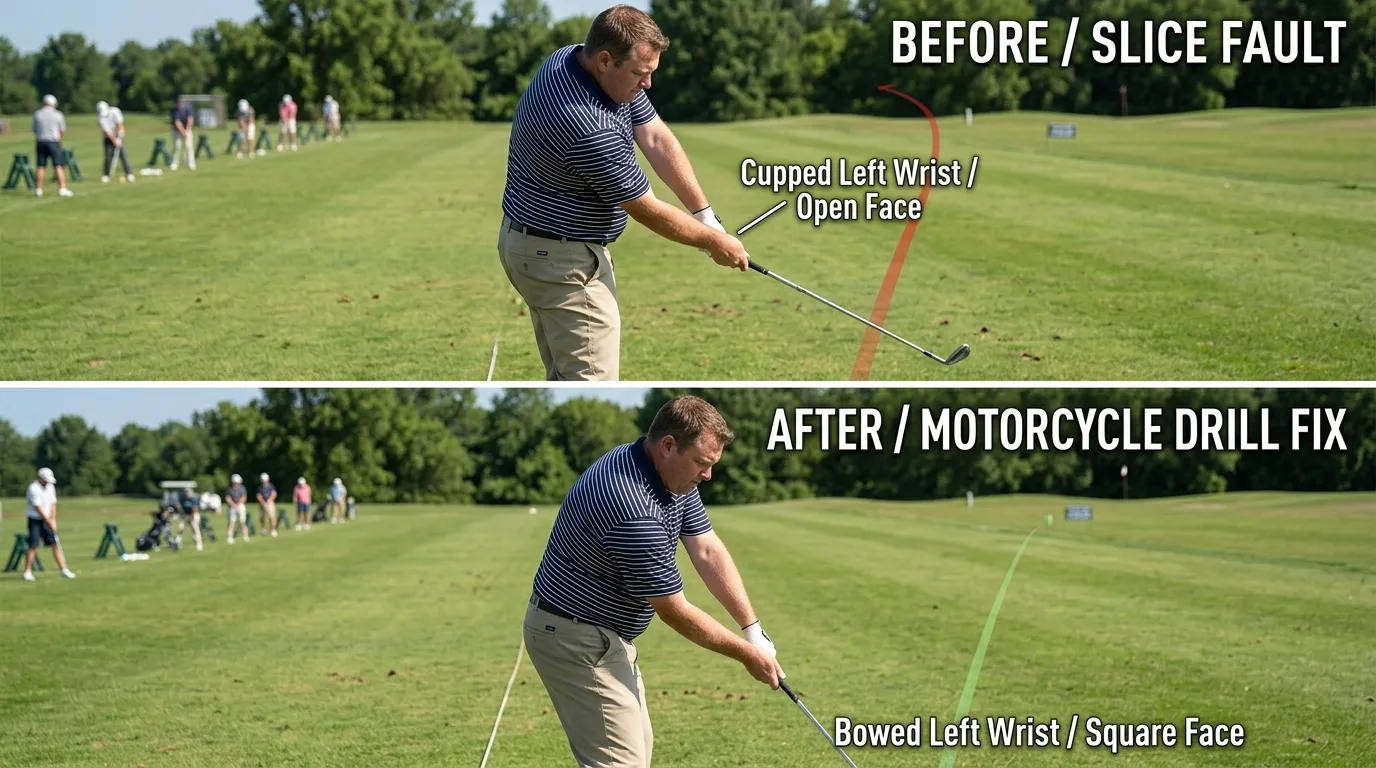
For right-handed beginners, an over-the-top swing path with an open clubface (a slice) accounts for most balls lost over the right-side white stakes. Working on a square clubface through our golf swing fundamentals guide and choosing a forgiving 10.5 to 12-degree driver from our beginner's guide to golf clubs will dramatically cut down your OB count.
5. Provisional Ball (Rule 18.3): Why you must say the words "provisional ball" out loud
Whenever your ball flies toward trees or white stakes and you cannot tell from the tee whether it stayed in bounds or went OB, Rule 18.3 lets you play a provisional ball before walking forward:
- You MUST announce the words "provisional ball" before hitting: Under Rule 18.3b, you must clearly tell your playing partners or caddie that you are playing a provisional ball and state how to tell the two balls apart (for example: "I'm hitting a provisional ball, Titleist number 3"). If you simply tee up a second ball in silence or say "Let me hit another one", the Rules automatically treat that second ball as your ball in play under stroke and distance (hitting 3), and your first ball is dead even if you walk up and find it sitting in the middle of the fairway!
- The 3-minute search rule: Once you reach the search area, you have 3 minutes to find your original ball. If you find the original ball In Bounds within 3 minutes, you must pick up the provisional ball (with zero penalty) and play your original ball as your 2nd shot. If the original ball lies OB or cannot be found within 3 minutes, the provisional ball becomes the ball in play and your next shot with it is your 4th stroke.
To brush up on related rules terms like lost ball, unplayable ball, or nearest point of complete relief, see our glossary of golf terms.
6. Color-coded stakes comparison: White vs Red vs Yellow vs Blue stakes
Golf courses use four stake colors to signal very different relief procedures. Confusing white stakes with red stakes is one of the most common rules errors on the course:
| Stake / Line Color | Official Rule Meaning | Can You Pull Out the Stake? | Relief Options & Penalty |
|---|---|---|---|
| White Stakes | Out of Bounds (OB - Rule 18.2) | NO (Fixed boundary object; 2-stroke penalty if removed) | Cannot play the ball. 1-stroke penalty + replay from previous spot (or 2-stroke fairway drop under Local Rule E-5) |
| Red Stakes | Red Penalty Area / Lateral Hazard (Rule 17) | YES (Movable obstruction) | Play as it lies (0 penalty), or take 1-stroke penalty to drop within 2 club-lengths of where the ball crossed the red margin |
| Yellow Stakes | Yellow Penalty Area (Rule 17) | YES (Movable obstruction) | Play as it lies (0 penalty), or take 1-stroke penalty for stroke-and-distance or back-on-the-line relief (no lateral drop) |
| Blue Stakes / Enclosed White Line | Ground Under Repair (GUR - Rule 16.1) | YES | FREE RELIEF (0 penalty): drop within 1 club-length of the nearest point of complete relief outside the GUR |
7. Internal OB: Why a ball on the next hole's fairway can still be Out of Bounds
First-time players are often baffled when their tee shot on Hole 1 slices through a line of trees, lands squarely in the middle of the mowed fairway on Hole 9, and the caddie informs them the ball is Out of Bounds. This is known as Internal OB (Internal Out of Bounds).
_20260203_154537_684251.webp)
At busy parkland layouts with parallel holes running side by side, such as Tan Son Nhat Golf Course in Ho Chi Minh City or Song Be Golf Resort in Binh Duong, the Committee places a line of white stakes along the tree line separating two holes. The Local Rule on the scorecard specifies that while playing Hole 1, the area beyond the white stakes on Hole 9 is Out of Bounds. This stops players from taking dangerous shortcuts down an adjacent fairway toward oncoming groups. Once you are actually playing Hole 9, those same internal stakes have no status for that hole.
8. Frequently asked questions about Out of Bounds (OB) in golf
If my first tee shot goes OB, what stroke am I hitting when I tee up again?
You are hitting your 3rd stroke ("one out, two in, hitting three"). Your original tee shot was stroke 1, the stroke-and-distance penalty under Rule 18.2b adds stroke 2, so the ball you tee up and hit again is stroke 3.
Is a golf ball touching the white OB line in bounds or out of bounds?
Under Rule 18.2a(2), the painted white line itself is out of bounds. However, a ball is only OB when 100% of the ball lies outside the boundary edge. If any tiny part of the ball touches or overhangs the course-side (inside) edge of the white line, the ball is IN BOUNDS.
Can I pull out a white OB stake if it is in the way of my swing?
No. Unlike red and yellow stakes (which are movable obstructions), white OB stakes are fixed boundary objects under Rule 8.1a. You get no free relief from a white stake, and pulling or bending one to improve your swing path costs a 2-stroke penalty in stroke play.
Can I stand out of bounds to hit a ball that lies in bounds?
Yes, with zero penalty. The Rules of Golf only care whether the ball is in bounds, not where the player stands. You are completely free to plant both feet outside the white stakes to play a ball that lies inside the boundary edge.
What happens if I hit a second ball off the tee without saying "provisional ball"?
Under Rule 18.3b, if you do not explicitly announce that you are playing a provisional ball before hitting, that second ball immediately becomes your ball in play under stroke and distance (hitting your 3rd stroke). Your first ball is abandoned and out of play, even if you walk down the fairway and find it sitting in the middle of the short grass.
When can I use Local Rule E-5 to drop in the fairway for 2 penalty strokes?
Model Local Rule E-5 is used in casual rounds and club events that adopt it to speed up play, provided you did not already hit a provisional ball from the previous spot. You drop within two club-lengths inside the nearest fairway edge (no nearer the hole than where the ball crossed OB) and add 2 penalty strokes, hitting your 4th stroke from the fairway.
Looking for wide-fairway courses in Vietnam that forgive errant tee shots? WinGolf's operations team knows every layout in Hanoi, Ho Chi Minh City, Da Nang, and Nha Trang and can recommend beginner-friendly courses with transparent all-in packages (Green Fee + Caddie Fee + 1/2 Buggy).
Hotline / WhatsApp / Zalo: +84 985 092 088 · Email: booking@wingolf.com.vn
More from our golf knowledge section: what par means in golf · what is a golf handicap · golf swing fundamentals · golf clubs for beginners · essential golf terms.