
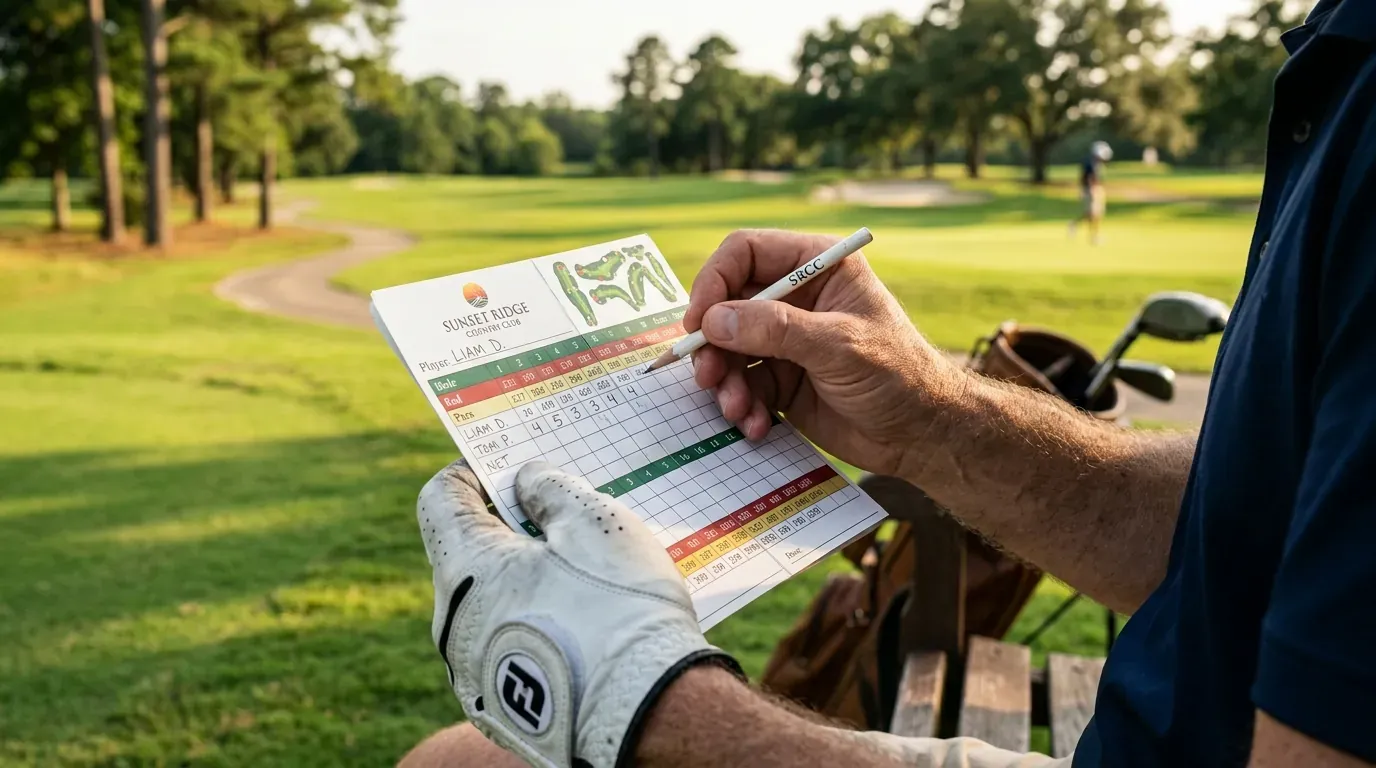
Birdie, Eagle and Bogey in Golf: Complete Scoring Chart Relative to Par
Time 03/11/2026
Ride in a buggy with a group of beginners on a Vietnam golf course and one question comes up almost every time: why is finishing one stroke under standard called a Birdie, two under an Eagle, and one over a Bogey? Instead of calling out raw numbers like 4 or 5 on every hole, golfers everywhere express scores by how many strokes they finish above or below Par.
This guide puts the entire scoring scale from Condor (-4), Albatross (-3), Eagle (-2) and Birdie (-1) through to Bogey (+1), Double Bogey (+2) and Double Par into one reference chart. You will see the exact stroke count for each score on Par 3, Par 4 and Par 5 holes, how caddies mark circles and squares on a paper scorecard, and why playing steady Bogey Golf lowers a beginner's score much faster than chasing birdies.
- Birdie (-1): One stroke under Par on a hole (2 strokes on a Par 3, 3 on a Par 4, 4 on a Par 5).
- Eagle (-2): Two strokes under Par (most often 3 strokes on a Par 5, or a Hole in One on a Par 3).
- Albatross / Double Eagle (-3): Three strokes under Par, an ultra-rare score (such as holing your second shot on a Par 5).
- Par (0): Completing the hole in the standard number of strokes (3 on a Par 3, 4 on a Par 4, 5 on a Par 5).
- Bogey (+1), Double Bogey (+2), Triple Bogey (+3): Finishing 1, 2 or 3 strokes over Par.
- Double Par: Twice the Par of the hole (6 on a Par 3, 8 on a Par 4, 10 on a Par 5), commonly used as the maximum pickup score in casual rounds and amateur outings.
1. Why golf scores revolve around Par and take their names from birds
Across a standard 18-hole golf course, holes vary widely in length: a short 140-yard hole takes 3 strokes (Par 3), while a 530-yard hole takes 5 strokes (Par 5). If you tell a friend you made a 4 on the 7th hole, they cannot tell whether that was a great result or a routine one without knowing the hole's Par. You can read how course architects set yardages for each hole in our guide to what Par means in golf.
Comparing the score against Par makes the result clear right away. Under-par scores (-1, -2, -3) mean you used fewer strokes than standard, and golf names them after birds of increasing wingspan: a small songbird (Birdie), an Eagle, a giant sea bird (Albatross) and an Andean Condor. Scores over standard (+1, +2, +3) belong to the Bogey family.
2. Complete scoring chart: strokes by Par, Stableford points and scorecard symbols
Under Rule 3.3 of the R&A and USGA Rules of Golf, stroke play requires recording your exact gross stroke count for each hole. Still, when keeping a paper scorecard by hand, players and caddies draw simple shapes around each number so anyone can add up the round in seconds. In Stableford competitions, each score relative to Par converts into points from 0 to 6.
| Term | Vs Par | Par 3 Hole | Par 4 Hole | Par 5 Hole | Stableford Points | Paper Scorecard Symbol |
|---|---|---|---|---|---|---|
| Condor | -4 | N/A | N/A | 1 stroke (HIO) | 6 points | 3 concentric circles |
| Albatross (Double Eagle) | -3 | N/A | 1 stroke (HIO) | 2 strokes | 5 points | 2 bold or shaded circles |
| Eagle | -2 | 1 stroke (HIO) | 2 strokes | 3 strokes | 4 points | Double circle around number (◎) |
| Birdie | -1 | 2 strokes | 3 strokes | 4 strokes | 3 points | Single circle around number (○) |
| Par | 0 (Even) | 3 strokes | 4 strokes | 5 strokes | 2 points | Plain number, no border |
| Bogey | +1 | 4 strokes | 5 strokes | 6 strokes | 1 point | Single square around number (□) |
| Double Bogey | +2 | 5 strokes | 6 strokes | 7 strokes | 0 points | Double square around number |
| Triple Bogey | +3 | 6 strokes | 7 strokes | 8 strokes | 0 points | Double square with diagonal slash |
| Double Par | +3 / +4 / +5 | 6 strokes (+3) | 8 strokes (+4) | 10 strokes (+5) | 0 points | Write cap number (6, 8, 10) |
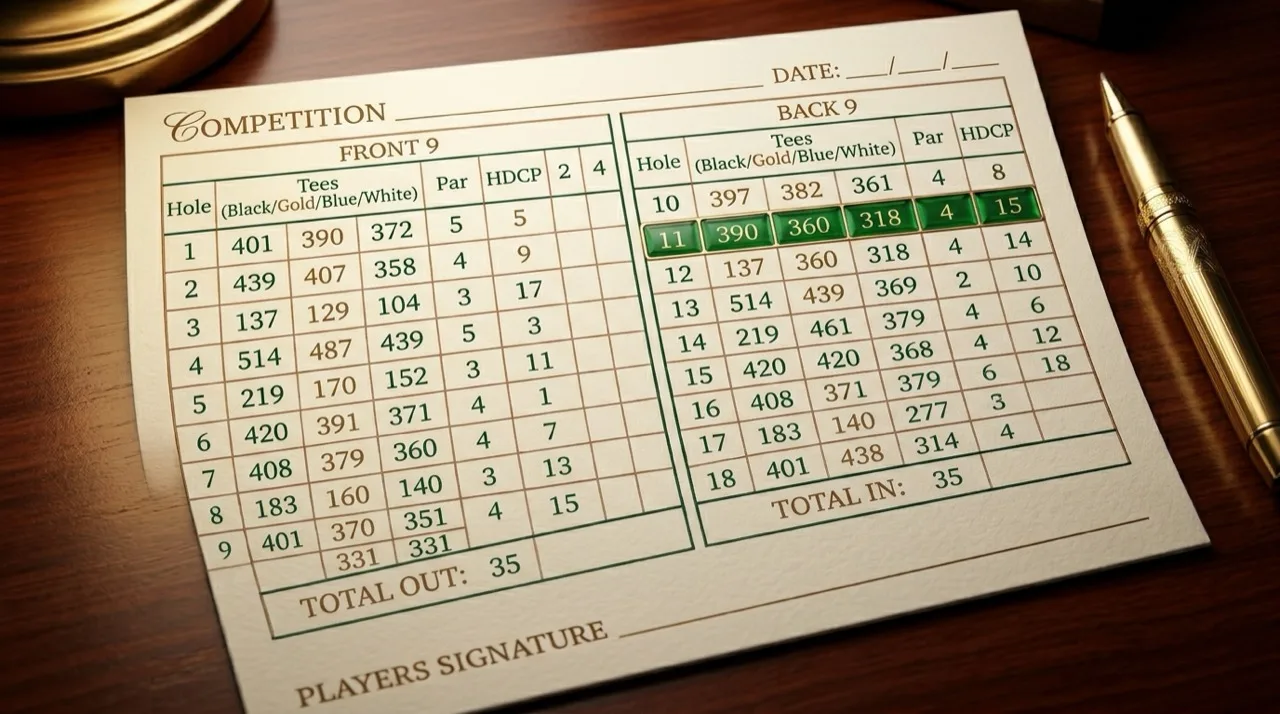
Caddie math shortcut: instead of adding 18 individual numbers like 5 + 4 + 6 + 3 and risking an arithmetic error, caddies count the squares (+1 for a single square, +2 for a double square) and subtract the circles (-1 for each circle). If your card has 14 single squares, 1 circle and the rest unmarked Pars, your net difference is +13. Add 13 to a Par-72 course and you have 85 right away.
3. Under-Par scoring terms explained: Birdie, Eagle, Albatross and Condor
Making a red number on a hole is what keeps golfers coming back. Here is how each under-par score got its name and how players actually make them on the course.
Birdie (-1): The 1899 Atlantic City origin and the easiest way for amateurs to make one
A Birdie in golf means holing out in one stroke fewer than Par: 2 strokes on a Par 3, 3 strokes on a Par 4, or 4 strokes on a Par 5. The textbook route to a birdie is hitting the Green in Regulation (reaching the putting surface in 1 shot on a Par 3, 2 shots on a Par 4, or 3 shots on a Par 5) and sinking the first putt. Any putt that would give you a score of -1 if it drops is called a birdie putt.
The word dates back to a round in 1899 at Atlantic City Country Club in New Jersey. Playing in a threesome with his brother William and friend George Crump, Abner Smith hit an approach shot that struck the flagstick and stopped inches from the cup. Someone in the group called out, "That was a bird of a shot!" In late-19th-century American slang, calling something "a bird" meant it was first-rate. The group agreed that holing the next putt for one under standard would pay double stakes and be called a "birdie". A granite marker still stands on the 12th hole at Atlantic City Country Club to mark the spot.
For weekend golfers, the best birdie opportunities come on short Par 5s (around 460 to 490 yards from the white tees). You do not need to reach the green in two shots like a tour pro. A 200-yard drive followed by a 170-yard fairway wood or hybrid leaves a third shot of 90 to 100 yards. From that wedge distance, knocking the ball within 6 to 10 feet of the pin gives you a realistic birdie putt.
Eagle (-2): Three ways it happens on the course
Needing a grander bird than a songbird for a score of two under Par (-2), American golfers named it the Eagle after their national symbol. On the course, an Eagle typically happens in one of three ways:
- On a Par 5 (3 strokes): This is by far the most common Eagle. Longer hitters who drive the ball 240+ yards can reach the green of a Par 5 in two shots (on in two) and sink the first putt. Shorter hitters make Par-5 Eagles by laying up to 30-50 yards in two shots and holing out a pitch or chip on their third stroke.
- On a Par 4 (2 strokes): After a tee shot into the fairway, the player holes out a full iron or wedge approach from 120 to 160 yards. On short, drivable Par 4s (under 310 yards), a player can also drive the green in one shot and make the putt for a 2.
- On a Par 3 (1 stroke): A Hole in One on a Par 3 finishes a 3-shot hole in 1 stroke, which counts as an Eagle (-2) on the scorecard.
Albatross / Double Eagle (-3) and Condor (-4): Golf's rarest scores
An Albatross (often called a Double Eagle in the United States) is three strokes under Par (-3). Mathematically, "Double Eagle" is a bit of a misnomer since doubling -2 would equal -4, which is why the R&A and international broadcasts prefer Albatross, named after the oceanic bird with an 11-foot wingspan.
Making an Albatross requires holing your second shot from 200+ yards out on a Par 5, or making a Hole in One on a Par 4. The odds of an amateur recording an Albatross are roughly 1 in 1 million to 1 in 6 million, making it far rarer than a Par-3 ace. One step further is the Condor (-4), a Hole in One on a Par 5 (usually achieved by cutting the corner over trees on a sharp horseshoe dogleg). Fewer than 10 Condors have ever been verified in golf history.
4. Over-Par terms: Bogey, Double Bogey and the story of Colonel Bogey
Every beginner's scorecard is filled with Bogeys, Double Bogeys and Triple Bogeys during the first year. Understanding where the term came from makes those squares on the card a lot less frustrating.
Bogey (+1): Why "Colonel Bogey" originally meant a scratch score
Today, a Bogey means finishing a hole one stroke over Par (+1): 4 strokes on a Par 3, 5 on a Par 4, and 6 on a Par 5. In 1890s Britain, before the USGA standardized Par in 1911, the word meant the exact opposite of a mistake.
In 1890, Hugh Rotherham, secretary of Coventry Golf Club, introduced a "Ground Score" representing the number of strokes a strong amateur should take on each hole. That same year, the music-hall song "Hush! Hush! Hush! Here Comes the Bogey Man" became a craze across England. During an 1891 match at Great Yarmouth Golf Club played against this fixed Ground Score, Dr. Thomas Browne remarked that this invisible opponent played so steadily he was a real "Bogey Man". British clubs soon gave the imaginary scratch player a military rank: Colonel Bogey.
When the rubber-cored Haskell ball arrived in the early 1900s and flew much farther than old gutta-percha balls, pros began beating Colonel Bogey's score by a stroke on most holes. In 1911, the USGA formalized a tougher standard called Par based on expert distance plus two putts. Old Colonel Bogey's benchmark was pushed to one stroke over Par (+1), where it has stayed ever since. For more everyday course expressions, check our complete golf glossary.
Double Bogey (+2) and Triple Bogey (+3): How one bad decision ruins a scorecard
Two strokes over Par is a Double Bogey (+2), three over is a Triple Bogey (+3), and four over is a Quadruple Bogey (+4). Watching hundreds of weekend groups across Vietnam, our operations team sees the same pattern behind almost every Triple Bogey: trying to pull off a low-percentage hero shot after a poor tee ball.
Picture a 380-yard Par 4 lined with mature trees and water hazards like those at Van Tri Golf Club. Your drive slices into the trees on the right. If you take an 8-iron and punch the ball sideways back onto the fairway (shot 2), hit your 3rd shot onto the green and take 2 putts, you walk off with a stress-free 5 (Bogey +1). Instead, most amateurs pull a 5-iron or fairway wood and try to thread the ball through a narrow gap in the branches toward the green. The ball clips a trunk and ricochets deeper into rough (shot 2), the rushed 3rd shot flies into a greenside bunker, the 4th stays in the sand, the 5th finally reaches the green, and two putts turn a routine Bogey into a 7 (Triple Bogey +3).
5. "Bogey Golf is Good Golf": Using Personal Par to break 90
Teaching pros repeat a simple truth: "Bogey golf is good golf". If you make a Bogey (+1) on all 18 holes of a Par-72 course, your total score is 72 + 18 = 90 strokes. According to USGA data and handicap apps in Vietnam, fewer than 30% of recreational golfers consistently shoot 90 or better. You can see how a score of 90 translates into an official index in our guide to what a golf handicap is.
The biggest mistake beginners shooting 100 to 115 make is reading "Par 4" on the tee sign and forcing themselves to reach the green in two shots. If your average drive goes 160 to 180 yards, you still have 190 yards left on a 360-yard hole. Swinging hard with a 3-wood off the turf usually produces a topped shot or a ball in the hazard. If you are preparing for your first rounds on grass, read our beginner's guide to playing golf first.
The "Personal Par" (+1 per hole) method for 18-36 handicappers: Add 1 stroke to every hole printed on the scorecard. Treat every Par 3 as a 4-shot hole, every Par 4 as a 5-shot hole (plan to reach the green in 3 strokes and take 2 putts), and every Par 5 as a 6-shot hole (reach the green in 4 strokes plus 2 putts). Giving yourself 3 shots to reach a Par-4 green lets you hit your most reliable beginner golf clubs like a 7-iron, 8-iron or hybrid instead of forcing a difficult fairway wood.
Put this mindset to work on courses with strong valley winds and water-guarded greens like Thanh Lanh Valley Golf & Resort. Laying up short of the water on your second shot and chipping onto the green with your third takes double bogey out of play, and whenever you sink a one-putt, you walk away with an actual Par.
6. Frequently asked questions about Birdie, Eagle and Bogey
How many strokes is a Birdie in golf?
A Birdie is always one stroke under the Par of the hole (-1). That means 2 strokes on a Par 3, 3 strokes on a Par 4, and 4 strokes on a Par 5.
What is the difference between an Eagle and a Double Eagle (Albatross)?
An Eagle is 2 strokes under Par (-2), such as finishing a Par 5 in 3 strokes or a Par 4 in 2 strokes. A Double Eagle, called an Albatross outside the US, is 3 strokes under Par (-3), such as holing your second shot on a Par 5 or making a Hole in One on a Par 4.
Does a Hole in One on a Par 3 count as an Eagle?
Yes. Because a Par 3 has a standard score of 3, holing out in 1 stroke puts you at 2 strokes under Par (-2) for that hole, which is an Eagle.
What does Double Par mean and why do amateurs pick up the ball there?
Double Par is twice the Par of the hole: 6 strokes on a Par 3, 8 on a Par 4, and 10 on a Par 5. In casual rounds and many corporate golf outings in Vietnam, organizers set Double Par as the maximum score per hole so players can pick up their ball once they hit the limit, keeping pace of play moving for groups behind.
What do circles and squares mean on a golf scorecard?
On a handwritten scorecard, a single circle around the number marks a Birdie (-1), a double circle marks an Eagle (-2), an unmarked number is a Par (0), a single square marks a Bogey (+1), and a double square marks a Double Bogey (+2).
What is Bogey Golf and how long does it take a beginner to reach it?
Bogey Golf means averaging +1 per hole, or shooting 90 on a Par-72 course (roughly an 18 Handicap). Beginners who take lessons and play 2 to 3 rounds a month typically need 8 to 18 months to shoot around 90 consistently.
Book tee times & pick the right course with WinGolf: Our operations team knows the layout and difficulty of over 70 courses across Vietnam, securing preferred tee times, buggies and experienced caddies for your group.
Hotline / WhatsApp / Zalo: +84 985 092 088 · Email: booking@wingolf.com.vn
More from our golf knowledge section: what Par means in golf · what is a golf handicap · glossary of golf terms · how to play golf for beginners · choosing golf clubs for beginners.